

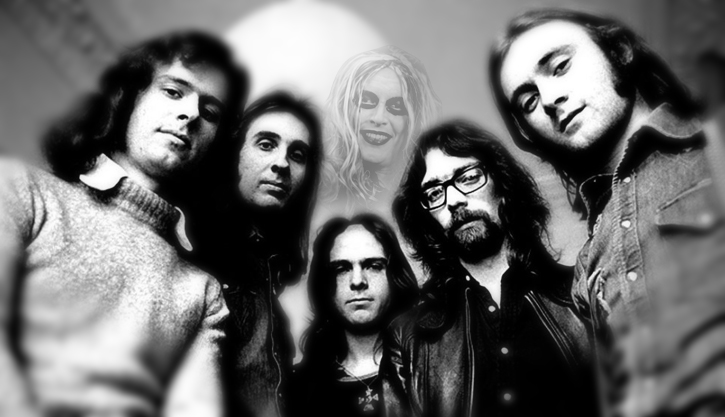
Genesis: The Band Everyone Loves to Hate
(Until They Actually Listen)
Genesis. The band everyone loves to hate.
And honestly? From a certain perspective, I can understand why. When a band becomes that big - and Genesis were absolutely everywhere in the 1980s - backlash is inevitable. Invisible Touch alone made them the first band to land five U.S. Top 5 singles from one album, a level of saturation that practically invites eye‑rolling from anyone who prides themselves on being “edgy.”
Phil Collins, especially, became unavoidable. His voice, his face, his solo career, his movie soundtracks — he was the soundtrack of malls, car radios, and most every parents’ living room. And for some people, that’s enough reason to dismiss a band outright. It’s cool, at a certain age, to reject whatever your parents love.
But I'm not gonna fall.. for that 'banana in the tailpipe'....
The Sessions
The album is a collection of cover songs spanning from the 1970s through the 2000s. I handled drums, guitars, keyboards, and lead vocals, while Ron covered bass, additional keyboards, and a generous share of backing vocals. We also welcomed a few guest musicians into the studio along the way, including Billy Price and Bernard Smith — each visit adding its own spark and sense of occasion to the recordings.
A Band of Adults in a World of Rock Excess
What so many people don’t realize is that Genesis didn’t start out as commercial hitmakers. Quite the opposite: for the first half of their career, they were one of the most accomplished musical collectives that England — or the world, for that matter — had ever seen. A band known for crazy time changes, incredibly creative chord structures and melodies, vast lyrical content, all wrapped in a bow of theatrical performance, at a time when most other groups settled for 4/4 while wearing jeans and t shirts.
One thing I’ve always respected about Genesis is that they weren’t the stereotype of the hard living, hotel destroying rock band. They were adults. They were musicians. They were disciplined. At a time when many bands were embracing excess and simplicity, Genesis were building theatrical, musically ambitious works that demanded attention, patience, and repeated listening. They were searchers... experimental.
And experiment they did.
Genesis were the first band to use the Vari‑Lite, the moving spotlight system that revolutionized live concerts and is now standard worldwide.
They also sold over 150 million albums, and remain the only band to produce two lead singers — Phil Collins and Peter Gabriel — who each won the British Male Solo Artist award.
That’s not just success. That’s legacy.
The Fox Head, the Red Dress, and the Moment Genesis Became "Genesis"
One of my favorite musical stories of all time comes from the early 70s. During a show, Peter Gabriel vanished mid‑set and suddenly re‑emerged wearing a red dress and a fox head, without telling the band he was going to do it. He just wanted to give them “a bit of a wobbly.”
Instead, he gave the press a field day — and gave Genesis a visual identity that would begin to define their progressive era.
This was Genesis at their most theatrical, imaginative, and boundary pushing. They weren’t reacting to the culture around them — they were creating their own. That kind of fearless creativity is rare in any era.
From Progressive Oddballs to Chart‑Topping Giants
It’s fascinating to look back at their beginnings - a group of Charterhouse schoolmates writing long, complex, high‑concept progressive rock - and realize that this same band would later dominate global pop charts. Genesis were pioneers of progressive rock in the 1970s, crafting albums like Trespass, Foxtrot, Selling England by the Pound, and The Lamb Lies Down on Broadway.
Then, after Gabriel left in 1975 and Steve Hackett in 1977, the remaining trio - Banks, Rutherford, and Collins - reinvented themselves. Their albums Duke, Abacab, Genesis, Invisible Touch, and We Can’t Dance were all commercially massive.
And in one of the most poetic chart moments in music history, Genesis’s “Invisible Touch” hit #1 the same week Peter Gabriel’s “Sledgehammer” sat at #2.
It was a remarkable moment that spoke not only to their success, but to the extraordinary depth of talent that existed within Genesis itself.
Experimentation Was in Their DNA
People forget that Genesis were every bit as experimental as the Beatles — just in a different direction. They were early adopters of drum machines, synthesizers, and unconventional song structures. They were using technology in the early 80s that would later become the backbone of modern pop and hip‑hop production.
And the irony? They had one of the greatest drummers of all time in the band!
Speaking of Phil…
Phil Collins: The Accidental Frontman
Phil Collins’ origin story in Genesis is one of my favourites. When he auditioned as a drummer, he listened to the other candidates from Peter Gabriel’s parents’ swimming pool, picking up on what the band liked and disliked. Then he walked in and nailed it.
Years later, when Gabriel left, the band auditioned hundreds of singers. Collins coached them through the songs - and through this process he and the band would realize he could sing them better than any of them.
He didn’t seize the spotlight. The spotlight found him.
I’m Not Alone in My Admiration
When I picture the five core members — Gabriel, Banks, Hackett, Rutherford, and Collins — holed up in a cottage in the English countryside, writing the mind‑bending masterworks of their progressive era, it feels almost mythic. These were young men creating elaborate musical worlds, pushing boundaries, and refusing to compromise.
They weren’t chasing hits. They were chasing ideas.
I love Genesis. I’m in good company, too. Among the notable Genesis admirers:
John Lennon — praised Selling England by the Pound.
John Bonham — played Genesis songs with his son Jason.
Sarah McLachlan — cites The Lamb Lies Down on Broadway as an influence.
Jeff Buckley — covered “Back in N.Y.C.” live.
Princess Diana — reportedly loved A Trick of the Tail.
Robert Downey Jr., Bruce Willis, Robin Williams — all known fans.
When people across genres, generations, and backgrounds converge on the same band, it means something.
Why Genesis Matters to Me
While I don’t know all the reasons these people revere Genesis, I know why I do:
Musicianship — They could actually play.
Creativity — They built worlds, not just songs.
Discipline — They worked. Hard.
Freedom — They reinvented themselves multiple times.
Groupthink (in the best way) — They collaborated deeply.
Fearlessness — They took risks that could have ended their career.
Evolution — They never stayed still.
From long, complex, high‑brow art rock to concise, radio‑friendly pop, Genesis were always moving, always exploring, always refusing to be boxed in.
They were competent, respectable, responsible mavericks.
And perhaps, for someone reading this, it might be the beginning of discovering one of the most creative and ambitious catalogues in modern music history.